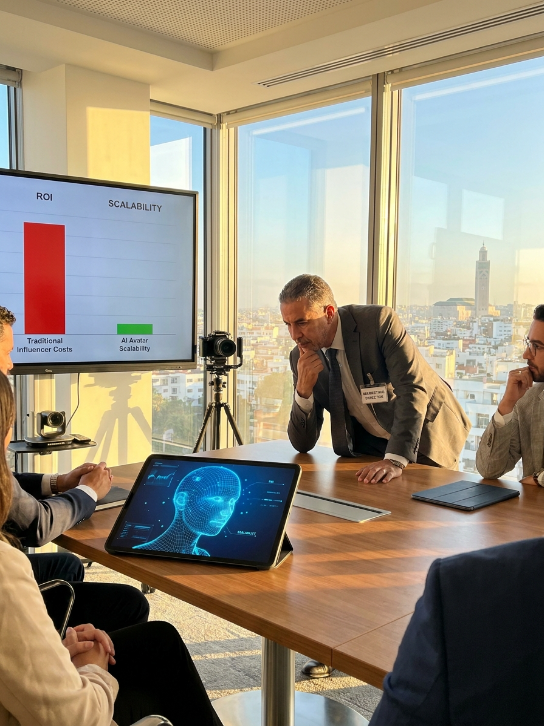
For corporate brands and marketing directors in Morocco, the influencer marketing ecosystem has reached a breaking point. Talent fees are skyrocketing, scheduling logistics for high-end commercials are a nightmare, and the PR risks associated with human creators are entirely out of the brand’s control.
The shift toward AI-generated talent is no longer just a futuristic concept; it is a financial necessity. But when brands approach an agency to replace or supplement their human talent roster with a digital persona, the first question is always: What is the actual cost of virtual influencer marketing in Morocco?
Table of Contents
The short answer is that while the initial setup requires investment, owning a localized AI avatar reduces long-term commercial production costs by up to 80%. Here is the exact breakdown of how the pricing works, where the ROI comes from, and what brands need to know before commissioning an AI persona.
1. The Hidden Costs of Traditional Influencers vs. AI Scalability
To understand the cost of a virtual influencer, you must first look at what you are currently spending on human talent. A standard mid-tier to macro-influencer campaign in Morocco involves:
- Talent Fees: Per-post or per-campaign rates that vanish the moment the campaign ends.
- Production Logistics: Location scouting, equipment rentals, lighting crews, and catering.
- Inflexibility: If a product label changes or a brand message shifts after the shoot, you have to pay for costly reshoots.
With a custom virtual influencer, you are shifting from an expense model to an asset model. Our General Manager, often notes during high-level client consultations that the biggest financial drain in traditional marketing isn’t the influencer’s fee—it is the unpredictable production overhead. Once an AI avatar is built, those logistical costs drop to near zero.
2. Phase One: The Initial Avatar Development Cost
The primary cost of virtual influencer marketing is the upfront development. You are not just buying a static face; you are commissioning a highly engineered digital asset. The cost here depends entirely on the required fidelity.
For premium B2B applications—such as a brand needing a hyper-realistic ambassador for national commercials—the development phase includes:
- Cultural and Aesthetic Engineering: A generic AI face will not convert in North Africa. The persona must be built with strict localized traits. For example, when engineering our Moroccan-focused persona, Mounia Skkalli, every detail—from the exact shade of her brown eyes to her culturally respectful attire—was hard-coded into the master models.
- Technical Asset Creation: This involves training custom models using top-tier image and video architecture (like Nano Banana Pro and Veo) so the avatar remains perfectly consistent across thousands of future generations.
The Financial Takeaway: The initial build requires a solid investment, typically structured as a flat project fee, but it results in a proprietary brand ambassador that you fully own and control 24/7.
3. Phase Two: The Cost Per Asset & Production Retainers
Once the virtual influencer is built, the cost structure shifts to content production. This is where the 80% cost reduction is realized.
Instead of flying a crew to Marrakech or Casablanca for a one-day shoot, your agency can generate a month’s worth of high-fidelity social media content and commercial video from a studio.
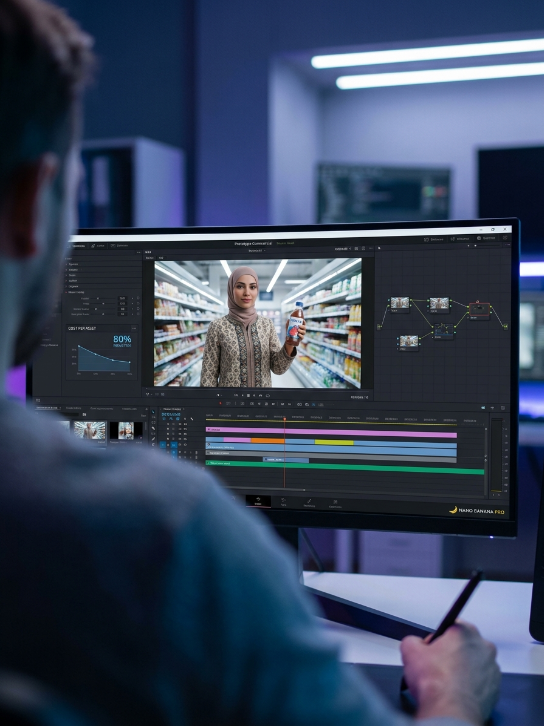
- Social Media Retainers: Generating photorealistic, first-person “selfie” perspective lifestyle posts for Instagram or TikTok is highly scalable. Pricing is usually handled via monthly retainers based on the volume of content required.
- AI Commercial Production: Creating full 15-to-30-second commercial video spots with fluid motion, lip-syncing, and localized voiceovers requires immense compute power and advanced video models. While this carries a higher per-asset cost than a static image, it is still a fraction of the cost of a traditional film crew.
4. De-Risking the Investment: The “Shadow Marketing” Strategy
One of the biggest hesitations brands have regarding the cost of AI is the fear of the unknown. Will it look realistic enough for a major retail holding company? Will the audience accept it?
As Houda, our Partnership Manager, emphasizes when mapping out commercial strategies with new clients, the best way to prove ROI is to see it in action before the main budget is spent. We utilize “Shadow Marketing” to de-risk the investment. Instead of asking a brand to sign off on a massive contract based on a concept deck, we produce a localized, high-fidelity prototype commercial featuring an AI avatar holding the brand’s actual product.
This prototype approach drastically shortens the sales cycle and proves exactly what the brand is paying for before the full campaign launches.
The Final Verdict on ROI
The cost of virtual influencer marketing in Morocco should not be viewed as a line-item expense, but rather as an investment in digital infrastructure. You are buying speed, infinite scalability, and absolute brand safety. When you eliminate the human bottlenecks of content creation, your cost-per-acquisition (CPA) drops, and your marketing agility skyrockets.